Coat of Arms
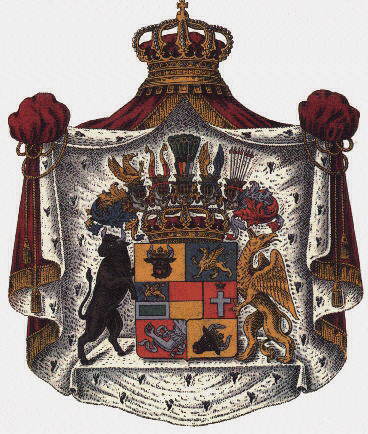
The coat of arms of Mecklenburg symbolizes the individual governments, that, in the course of history joined to form the country of Mecklenburg:
|
|
|
1. Coat of Arms of the Duchy (Herzogtum) of Mecklenburg
2. Coat of Arms of the Rostock District (Herrschaft)
3. Coat of Arms of the Principality (Fürstentum) of Schwerin
4. Coat of Arms of the Principality (Fürstentum) of Ratzeburg
5. Coat of Arms of the Stargard District (Herrschaft)
6. Coat of Arms of the Werle District (Herrschaft)
7. Coat of Arms of the "Grafschaft" Schwerin
|
|
History of Mecklenburg in 25 Facts
| Year |
Mecklenburg |
America |
Garling |
| 500-999 |
995
First documentary evidence of the "Michelenburg" (i.e. in 1995 we had the 1000th Anniversary of Mecklenburg) |
982, ...
The vikings (Erik the Red, his son Leif Eriksson) discover Greenland and sail on to Boston |
|
| 1000-1499 |
1160
Heinrich the Lion beats the Obotriten, the town of Schwerin was founded, imigration from German areas (west of river Elbe) started; 1220
Monastary Dobbertin was founded,
1229
First major partition in Mecklenburg: Principality Mecklenburg, Principality Rostock, Principality Parchim-Richenberg, Principality
Werle-Güstrow |
1492
Columbus discovers America |
|
| 1500-1549 |
|
1511
Conquest of Cuba by Spanish troops
1536
Cortes discovers California |
1540
A Mecklenburg tax list shows Hans Garling in Oldenstorf (probably the ancestor of Hans Garling - see footnote Hans below) |
| 1550-1599 |
|
1584
W. Raleigh founds Virginia, the first English settlement in America is Jamestown (VA) 1607 |
|
| 1600-1649 |
1621
Second major partition in Mecklenburg: Duchy Mecklenburg-Schwerin, Duchy Mecklenburg-Güstrow
1618-1648
The Thirty-Years' War
destruction and many human sacrifices in Mecklenburg; in this time: 1627-1631 -Wallenstein's forces in Mecklenburg, Swedish government after
that (alliance of March 13th, 1632); coming and going of Swedish and imperial forces
1645
Passing of the "rabble- and farmers' order" |
1619
The first slaves are brought from Africa to Virginia by Dutchmen
1626
Foundation of New Amsterdam (today New York) |
1601
The "Kieler Erbebuch" (heritage book of the town Kiel) mentions Claus Garlingk in March 1601
1642
Marten Garling marries Maria Rangen February 28, 1642 (churchbook Lohmen)
1644
Peter Garling marries Ilse Schmiede October 27, 1644 (churchbook Lohmen) |
| 1650-1699 |
1654
Ammendment to the "rabble- and farmers' order" regarding serfdom
1674-1675
Brandenburg-Swedish War in Mecklenburg |
1681
W. Penn receives Pennsylvania from Great Britain, 1683 Philadelphia is founded |
|
| 1700-1749 |
1700-1721
Northern War
lootings by the opponents: Swedish vs. Prussians, Danish, Saxons, and Russians
1701
Third major partition in Mecklenburg: Duchy Mecklenburg-Strelitz, Duchy Mecklenburg-Schwerin
1711
Start of the deportments of mecklenburger citizens into the Prussian army |
|
1716
The "Ordnung der Litzenbrüder" (statute of the Litzen brothers) of the town Hamburg is signed (among others) by Michel Garling
1721
Hinrich (Hans? see footnote) Garling, son of Hinrich Garling, marries Maria Elisabeth Meyer November 14, 1721 (churchbook Dobbertin)
1728
Hans (see footnote) Garling obtains a farm in Mestlin February 14, 1728 (official records of the Dobbertin monastery) |
| 1750-1799 |
1755
Constitutional law of succession; another embodiment of serfdom
1756-1763
Seven-Year-War
Prussia occupies neutral Saxony and fights against a coalition of Austria, Russia, France, and Sweden; in the course of the war repeated
occupation of Mecklenburg by Prussia; continued financial aid and payments in kind; enforced recruiting and looterings |
1754/55-1763
British - French Colonial War
1775-1783
North American War of Independence; 13 British colonies become independent and establish the United States of America; July 4, 1776 Declaration
of Independence, 1789 G. Washington is elected first President, 1790 Washington is the capital |
1751
Johannes Jacob Gerling (Garling) arrives in Philadelphia, PA from Rotterdam (see footnote Book 1); his son Jacob Gerling (born April 3,
1766) marries Elizabeth
1765
Michael Garling lands on the New England coast and settles in Schuylkill county, PA (see footnote Book 2); his son John Garling (born
April 20, 1791 Schuylkill county, PA) marries Catherine Hummel April 10, 1818
1776
Thomas, Gideon and John Garling are mentioned in the Revolutionary War Rolls (September 16, 1776; 2nd Regiment in the State of New Hampshire to
Join the Continentel Army in New York)
1776
In the Roll of Captain Lewis Farmer's Company the Private George Garling is mentioned, George is missing since August 27, 1776
1780
A True list from The Captain WETSTONS Company in Braunshweig Township in the 3rd Battalion, Berks County Militia, PA; commanded by Colonel John
Michael Lindenmuth; April the 28th 1780: Martin Garling is mentioned in the 6th class |
| 1800-1849 |
1806
Blücher's escape through Mecklenburg
looterings, destruction by the French
1806-1813
French time
(forced) entry in the Napoleon Rhein-Alliance 1808 (Confederation of the Rhine), billeting and forced recruitings for the fight versus Russia in
1812: 2100 citizens of Mecklenburg (less than 100 survived)
1813-1815
War of German Liberation versus Napoleon
1815
Congress in Vienna
Mecklenburg-Schwerin and Mecklenburg-Strelitz become Grand Duchies
1819
Beginning of the abolishment of serfdom
1848/49
Revolution (but failed in Mecklenburg) |
1845
Texas is the 28th state of the USA |
1815
Frederick Garling (born 1775 as the son of Nicholas Garling, a London, Great Britain architect, died 1848) arrives August 8, 1815 in Sydney,
Australia; he inhabits high Justice positions and is the ancestor of most Autralian Garlings |
| 1850-1899 |
1851
Beginning of mass emigration to America
1871
Founding of the German Empire, Mecklenburg Duchies joined, in 1934 both Duchies were united into a single German state of Mecklenburg |
1861-1865
American Civil War; the Confederate States of America are founded by 11 states; May 26, 1865 the Confederation surrenders
1865
Lincoln officially abolishes slavery |
1856
Johann Carl Jochim Christian Garling (* March 18, 1833 Ruest, Mecklenburg; + April 29, 1902 Mayville, WI), descendant of Hans (see
footnote), emigrates from Hamburg on the ship Elbe; he arrives on September 30, 1856 in New York, and is naturalized September 30, 1884 |
| 1900-1949 |
1914-1918
First World War
1939-1945
Second World War |
1917
USA joins WW I
1941
USA joins WW II |
|
| 1950-... |
1952
Mecklenburg and Vorpommern were replaced by the districts ("Bezirke") Rostock, Schwerin, and Neubrandenburg
1990
The districts were replaced again by "Mecklenburg-Vorpommern" (Vorpommern is the western part of Pomerania) |
1950-1953
Korean War
1963
November 22, 1963, J. F. Kennedy is murdered
1964-1973
Vietnam War
1820-1981
50.3 million people immigrated in USA, among them 6.99 million Germans |
1998
The German phone book shows 245 Garling's (www.teleinfo.de) and the American one 460 (www.switchboard.com) |
Book 1: Paul E. Garling: The Garling Family from 1751 to 1953; Kerr Printing Company Chambersburg, Pennsylvania 1954
Book 2: Abraham Crider: Genealogy of the Garling Family; compiled and written 1910
Hans: Hans Garling, born about 1688, he is the ancestor of all Mestlin / Ruest Garling's
Currency in Mecklenburg
 |
 |
| Taler 1864 |
 |
| Schilling 1844 |
 |
| Pfennig 1872 |
  |
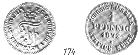
The three currency levels in Mecklenburg were: Taler, Schilling and Pfennig (symbols from left to right).
Till 1848 one 2/3 Taler was 32 Schilling, 12 Pfennig added up to one Schilling. Another name for the Mecklenburg 2/3 Taler was Gulden. To make the
Mecklenburg Taler compareable with the Taler in other German states, the value was defined: from 234 g silver 17 Taler were made.
From 1848 till 1873 one Taler was 48 Schilling, 12 Pfennig were one Schilling. I. e. 234g silver 14 (full) Taler = 21 Gulden (2/3 Taler) = 672
Schilling.
From 1873 on the German currency units were Mark and Pfennig (one Mark was 100 Pfennig).
And here some prices: in 1819 one "Pfund" (550 g) from 3 to 4 Schilling (source: Flasch, S.: Die Kosten einer Reise von Friedland nach
Sternberg vor 120 Jahren. - In: Mecklenburgische Monatshefte - Rostock 3 (1927) 8 - S.441.) and in 1848 a taxi ride within Schwerin 6 Schilling and a
ride to a suburb from 10 to 24 Schilling (of course it was a horse cab) (source: Jesse, W.: Geschichte der Stadt Schwerin. 2 Bde. - Schwerin:
Baerensprung, 1920).
The daily payment of a Tageloehner (day laborers) around 1820 was approx. 10 Shilling (men), 6 Shilling (women), a workday started at 5 am and
lasted till dusk (including a two hour break).
The first post stamps were selled in 1856, the last stamps in 1867. In 1868 Mecklenburg joined the "Norddeutscher Postbezirk", which
published own stamps
After 1-May-1848 one letter within a town costs 1/2 Schilling, upto 3 miles 1 Schilling, upto 6 miles 1 1/2 Schilling and above 6 miles 3
Schilling.
After 1-July-1867 one letter within a town costs 1/2 Schilling (upto 16,67 g = 1 Lot) and 1 Schilling (upto 15 Lot = 1/2 Pfd.), upto 5 miles 1
Schilling, from 5 to 10 miles 2 Schilling, from 10 to 20 miles 3 Schilling, and above 20 miles 5 Schilling.
Ancient History in Mecklenburg
Approximately 10,000 years ago Stone Age reindeer-hunters went through the cold steppe of the Post Ice Age. Later, settlements of hunters and
fishing people developed. Woodland was cleared to pursue farming. Towards the end of the 4th century the Eastgermanians started moving southward. The
formerly densely populated land grew to be deserted wilderness.
During the 6th and 7th century Slav tribes moved in from the east. The center of the Slav live were their fortresses. The expensionist tendencies
of the German emperors, kings and feudal lords, and especially the differences between Christianity and paganism, lead to constant fights between the
Germans and the Slav. In 1160 the Slav suffered their decisive defeat under the Obotritenfuerst Niklot against the Saxon king Henry the Lion.
The Development of Serfdom in Mecklenburg
Towards the end of the 12th and during the 13th century German colonists, primarily from Westphalia, settled in Mecklenburg. In progress of
colonization the first churches and monasteries were built. During colonization the land was being cultivated by free farmers that were obliged to pay
tax-like tributes ("Bede" and "Zehnt") as well as services to the prince and to church. Other than that they could work the way they
wanted to and live pretty well from their products.
Soon, agricultural businesses that usually belonged to knights developed in the villages. In the beginning they only difference between the
knights' and the peasants' farm steads was the bigger size and the breeding of draft horses and horses for fighting.
The power, especially the owning of land, was shared by sovereign (the duke, later the grand duke: "Dominalämter"), the clergy
(monasteries: monasterial offices), the cities and the rural secular aristocracy (knights, later landlords: knightly offices).
The knights became the heart of the armed forces. Based on this fact they were able to improve their social position in the 14th century. They
successfully fought for independence of the dynasty, richess and power. The sovereign gave them sovereign authorities. For example, knights were now
allowed to ask tributes and services from peasants, as well as they were now entitled to control jurisdiction. The sovereign also sold and pledged the
country's land. The peasants grew more and more dependant. Formerly free state subjects became estate subjects.
During the 30 Years War many villages became deserted, fields lay fallow. After the war the aristocracy (landlords, the new word
"knight" with its military meaning became less and less appropriate) found new ways to enrich themselves: First he took posession of abandoned
pieces of land. Not much later knights started violently taking land and forcing the peasants into serfdom. In 1654 serfdom was confirmed by law.
The social changes were reflected in village life as well: Instead of peasant's houses cottages for day-laborers were built. Instead of knightly
residences manors were being built. This way the land of "manors and cottages" developed. Until 1820 almost all knightly peasants had become
landless day- laborers.
In Mecklenburg serfdom took on propertions that were unknown in the other parts of Germany. Even though serfdom was officially abolished in 1820,
afterwards small farmers and hereditary leasehold steads were supported: the strong subjectal relations in Germany did not change very much till the
beginning of World War One.
Professions and related Terms in Mecklenburg
We find a lot of different rural professions: Tagelöhner, Knecht, Magd, Hauswirth, Hausmann, Büdner, Kossate, ... . These professions
are explained in the Mecklenburg FAQ.
|